

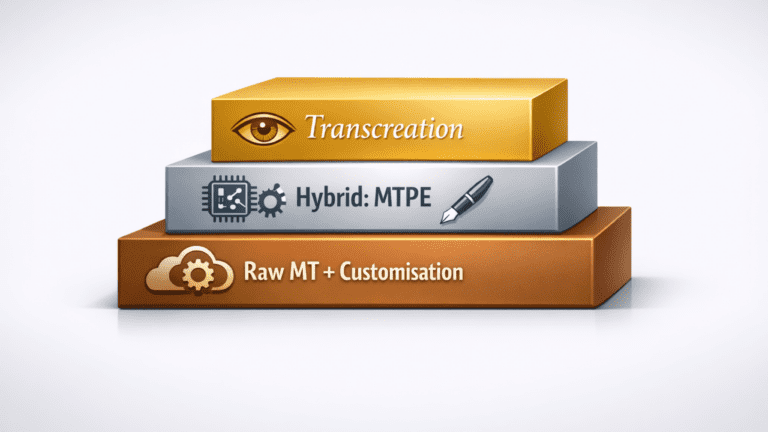
Why Smart Localisation Starts with Strategy, Not Software
Have you ever run your content through a machine translation tool and thought, “This is fine”? You’re not alone. Many businesses invest in translation software but end up with content that is technically correct yet off-brand.
The issue isn’t the technology. Modern machine translation tools are powerful. The real problem is treating localisation as a plug-and-play process when it actually requires a structured localisation strategy.
A well-defined localisation strategy helps businesses maintain brand consistency, reduce costs, and accelerate time-to-market. In this guide, you’ll learn how to combine human expertise with AI efficiency for better results.
The #1 Mistake Businesses Make with Translation Software
The most common localisation workflow mistake is using one translation tool for all content types — from homepage headlines to legal disclaimers and social media posts.
Different content types carry different levels of brand sensitivity and risk. A one-size-fits-all approach leads to:
- Overspending on low-risk internal documents
- Under-investing in high-stakes marketing content
- Inconsistent brand messaging across markets
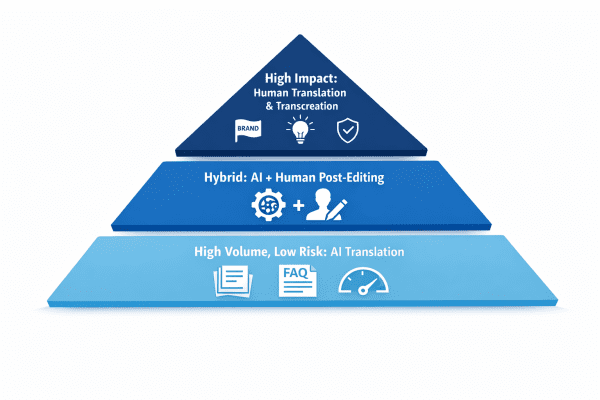
The solution is a tiered localisation strategy that matches the right translation method to each content type.
Start With Your Content, Not the Tool
Before choosing translation software, conduct a content-first audit:
- What types of content need localisation?
- How much creative nuance is required?
- What is the impact of incorrect terminology?
This audit forms the foundation of an effective localisation strategy and ensures resources are allocated efficiently.
The Result: A Partnership That Works
The most effective localisation strategies I see combine two or three approaches rather than applying one method to everything. It’s about matching the right method to the right content type, and then making sure the whole thing runs smoothly.
When brands take this structured approach, the results are clear: smarter budget allocation, faster time-to-market, and consistent quality that improves over time. Every edit, whether from an AI suggestion or a human review, feeds back into the system, making it smarter with every use.
If any of this resonates, I invite you to read our full article on Humanoid Translation to see how we’re empowering communication through this productive partnership.
Or, if you’d like to map out a strategy for your own content, let’s have a chat. Drop me a line at [your email address]—I’d be happy to discuss what might work for your team.
The Tiered Localisation Strategy Model
Tier 1 — High Impact: Human-Led Transcreation
For brand-critical content, professional linguists are essential. Transcreation preserves emotional tone, cultural nuance, and brand personality.
Best for:
- Brand taglines
- Advertising campaigns
- Legal documents
- Investor communications
Tier 2 — Hybrid Translation: AI + Human Review
A hybrid translation approach balances speed and quality. AI generates the first draft, while human editors refine tone and accuracy.
Best for:
- Blog posts
- Product pages
- Email campaigns
- Marketing content
Tier 3 — AI-Powered Translation for High Volume
AI translation works best for low-risk, high-volume content when configured properly.
Best for:
- FAQs
- Internal communication
- Knowledge base articles
- Support documentation
What a Good AI Translation Setup Looks Like
A strong localisation workflow includes:
- Translation Memory (TM): Ensures consistency and reduces costs
- Custom Glossary: Maintains brand terminology
- Style Guide Integration: Preserves tone and voice
With these foundations, AI translation aligns better with brand identity.
The Human-AI Partnership
The most effective localisation strategies combine human translators and AI technology. This hybrid approach delivers:
- Faster turnaround times
- Lower localisation costs
- Improved brand consistency
- Scalable global expansion
Conclusion
Localisation success starts with strategy, not software. By implementing a tiered localisation strategy and combining AI with human expertise, businesses can scale globally while maintaining brand voice and improving ROI