

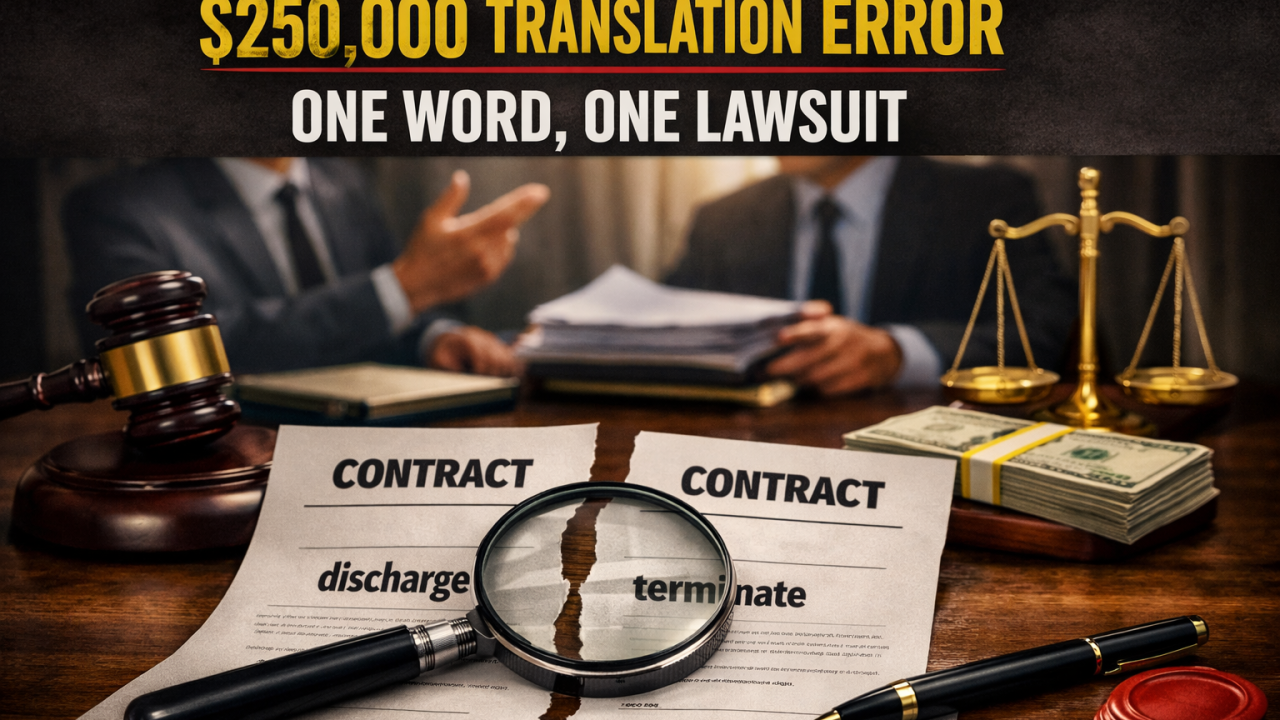
The Hidden Cost of “Good Enough” Translation in Legal Disputes
A single word cost one company $250,000. Here’s why certified legal translation is not a luxury — it’s liability protection.
Introduction (The Wake-Up Call)
A multinational company hired a new executive.
The employment contract was written in English. The executive’s native language was Spanish. As a courtesy, the company provided a “quick” Spanish translation — done by an intern who was a native speaker but had no legal training.
The contract said: “The non-compete clause applies for 12 months following termination.”
The intern translated it as: “La cláusula de no competencia se aplica durante 12 meses después de la terminación.”
Seems fine, right?
Wrong.
In that jurisdiction’s legal context, “después de la terminación” can be interpreted as “after the contract ends naturally” — not “after termination for any reason, including firing.”
The executive was fired for cause. They joined a competitor two weeks later. The company sued to enforce the non-compete.
The court ruled against the company.
The judge cited the ambiguous translation as evidence that the parties did not have a “meeting of the minds.”
Cost to the company: $250,000 in legal fees + lost trade secrets.
Cause of loss: One word. One missing legal distinction. A “good enough” translation.
At WordPar, we see this pattern repeatedly. Companies treat legal translation as an administrative task. Courts treat it as evidence.
Here is what every legal counsel needs to know before outsourcing another contract, affidavit, or verification letter.

The Three Legal Translation Mistakes That Lead to Lawsuits
Mistake #1: Using a “Native Speaker” Instead of a Certified Legal Translator
The false assumption: “If someone speaks both languages fluently, they can translate a contract.”
The reality: Legal translation requires:
- Knowledge of legal systems in both countries (civil law vs. common law)
- Understanding of legal terminology (e.g., “consideration” in contract law has no direct civil law equivalent)
- Familiarity with court requirements for sworn translations
Real example: A US company translated a French lease agreement using a bilingual employee. The French term “cautionnement” was translated as “deposit.” In French law, cautionnement is a personal guarantee — meaning the signer is personally liable for all rent, not just a deposit amount.
When the tenant defaulted, the company discovered they could only claim a small deposit, not the full rent. The employee’s translation had masked the true liability.
WordPar requirement: All legal translators must have:
- Law degree OR certified legal translation credential
- Minimum 5 years of experience
- Proof of professional liability insurance
Mistake #2: Confusing “Certified” Translation with “Notarized” Translation
The confusion: Many clients ask for a “notarized translation” when they actually need a “certified translation” — or vice versa. The two are not interchangeable.
Recommended by LinkedIn


Real consequence: A company submitted a notarized translation to USCIS for an H-1B visa petition. USCIS rejected it because they require a certified translation with the translator’s sworn statement. The petition was delayed by 4 months. The employee’s start date was missed.
WordPar solution: We ask every client: “Where is this translation going?” Then we provide exactly what that court or agency requires — certified, notarized, or both.
Mistake #3: Translating HR Verification Documents Without an Audit Trail
The hidden risk: You hire globally. You translate diplomas, reference letters, background checks, and employment verification letters.
If that translation is inaccurate — and you make a hiring decision based on it — you can be sued for:
- Negligent hiring
- Visa fraud (if submitted to immigration)
- Misrepresentation (if candidate claims translation error)
Real example: A company translated a candidate’s foreign diploma. The translator mistakenly wrote “Master’s Degree” instead of “Bachelor’s Degree.” The company hired the candidate for a role requiring a Master’s.
Later, the error was discovered. The candidate sued, claiming the company should have verified the translation. The translator had no audit trail — no proof of who did the work or when.
Settlement: $75,000.
WordPar requirement: Every HR verification translation includes:
- Full audit trail (who translated, when, their credentials)
- Copy of source document attached
- Translator’s sworn statement of accuracy
- Retention for 7 years (per employment law requirements)

WordPar maintains a directory of sworn, certified, and court-approved translators for 40+ jurisdictions. We do not guess. We verify before we assign.

One stat to remember: According to the American Translators Association, translation errors in legal documents have led to damages averaging $500,000 per case in commercial litigation.
Your legal translation budget is not an expense. It is liability insurance.

We do not say “all translators are equal.”
We say: “Give us your contract, affidavit, or diploma. We will return a translation that protects you in court.”