

Localization-First Design: Build Global-Ready Products
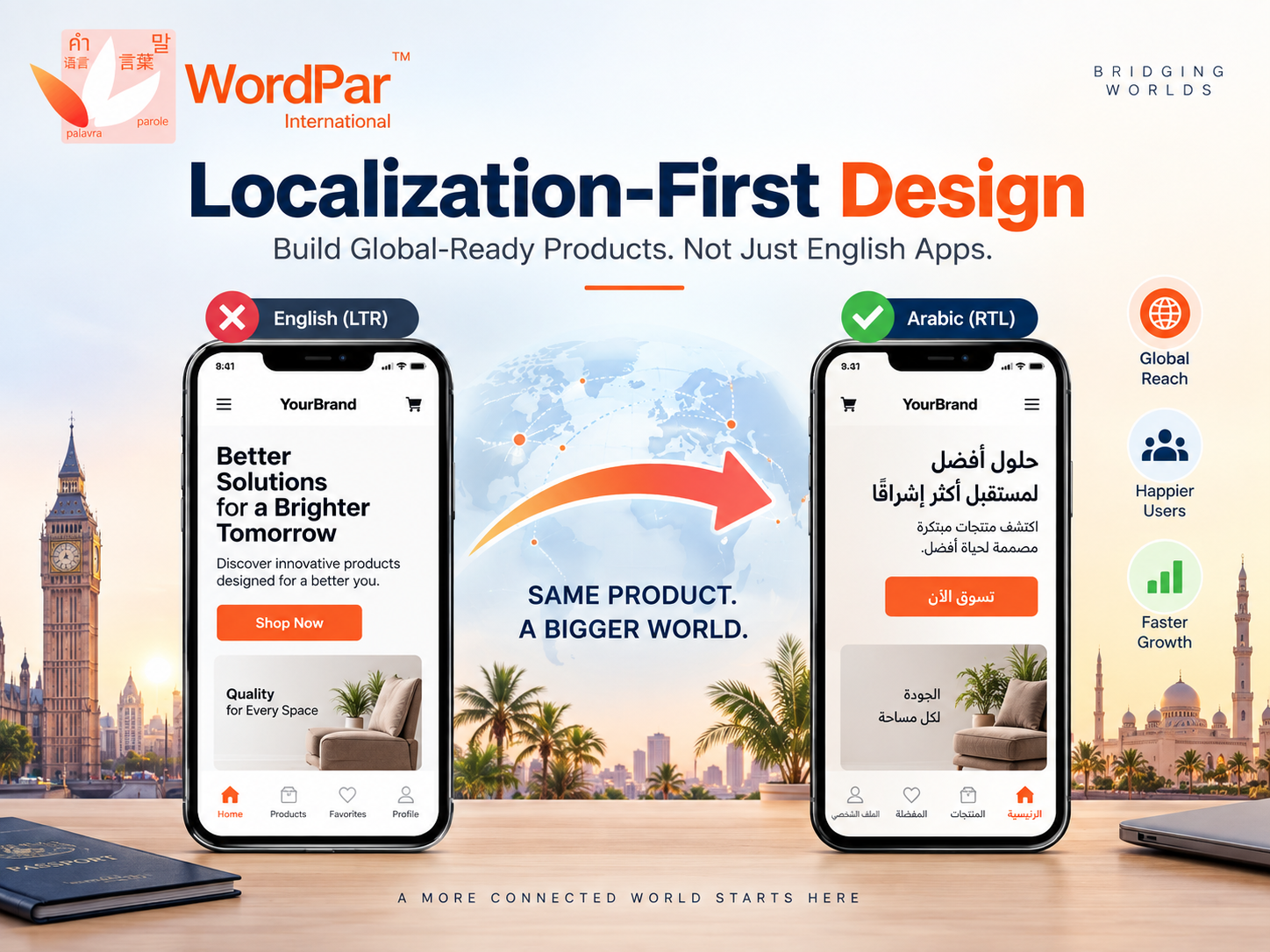
Retrofitting English apps with late-stage translations creates crippling technical debt, breaks RTL layouts, and delays global growth. Adopting Localization-First Design from sprint zero cuts engineering costs by 30x, delivers culture-fluid UX, and accelerates rapid international expansion.
The Days of "Retrofitting" an English App are Over: Why Localization-First Design Wins
For decades, the standard product development playbook followed a rigid, domestic-first pattern: build the core application strictly in English, validate it in Western markets, and treat language adaptation as a final packaging checkpoint. In 2026, this legacy approach of retrofitting localization into finished codebases is no longer viable. Fast-growing software companies and global tech enterprises have recognized that retrofitting breeds crippling technical debt, delays international go-to-market schedules, and alienates overseas audiences. Instead, forward-thinking product leaders are transitioning to Localization-First Design—an engineering and product architecture philosophy that prioritizes global usability and Internationalization (i18n) from day one.
[IMAGE: featured — alt: "Localization-First Design vs English app retrofitting architectural diagram showing RTL support and global UI"]
What Is Localization-First Design?
Localization-First Design is a proactive product engineering discipline that embeds international readiness, cultural adaptability, and linguistic flexibility directly into the software architecture from sprint zero. Rather than hardcoding user interface assumptions based solely on English and Western mental models, teams practicing Localization-First Design build modular layouts, decouple UI strings into resource bundles, engineer universal Unicode support, and accommodate regional behavioral expectations before writing a single line of production frontend code.
At its core, this paradigm shift ensures that global usability is not treated as an afterthought or an emergency patch. It empowers software applications to dynamically morph across writing systems, layout orientations, regional payment ecosystems, and cultural norms while preserving flawless performance and design integrity.
Why Does Retrofitting Localization Create Crippling Technical Debt?
When an application is conceived and built exclusively for English-speaking users, engineers make dozens of subtle structural assumptions that break when exposed to global markets. String concatenations (such as joining variables inside sentence fragments) ignore foreign grammatical syntax. Hardcoded container widths and static card heights shatter when encountering predictable text expansion and contraction. Databases configured with restrictive character sets choke on non-Latin scripts, exposing the absence of comprehensive Unicode support. Furthermore, UI navigation anchored strictly left-to-right collapses entirely when converted to Right-to-Left (RTL) Languages such as Arabic, Hebrew, Urdu, and Farsi.
Attempting to fix these fundamental architecture oversights after launch—the classic retrofitting localization trap—leads to compounding technical debt. Product engineering teams find themselves refactoring foundational components, splitting stylesheets, extracting thousands of hardcoded strings manually, and debugging broken layouts under extreme pressure. According to software economics benchmarks, resolving internationalization bugs in production creates up to 30 times more technical debt and cost than establishing Internationalization (i18n) standards during the initial architecture phase.
Why Localization-First Design Wins: The 4 Core Business Advantages
Adopting Localization-First Design delivers measurable competitive moats for modern SaaS platforms, mobile applications, and enterprise software:
- Dramatically Reduced Technical Debt: Eliminating hardcoded strings, brittle geometry, and directional CSS from the initial commit protects engineering teams from massive multi-quarter refactoring cycles.
- Superior Global Usability and Retention: Products engineered with a native-feeling culture-fluid UX resonate with local users immediately, driving higher activation rates, smoother onboarding, and reduced subscriber churn.
- Rapid Multi-Market Expansion: With technical Internationalization (i18n) scaffolding built into the codebase, launching in a new country requires only content translation and local compliance configuration rather than extensive code rewrites.
- Substantial Cost Efficiency: Proactive design and automated continuous localization prevent emergency sprint disruptions, UI redesigns, and expensive hotfixes across localized builds.
Comparison: Retrofitting English Apps vs. Localization-First Design
The operational, technical, and financial differences between reactive retrofitting localization and proactive Localization-First Design are stark across every stage of the software lifecycle:
| Architecture Dimension | Legacy English "Retrofit" Approach | Modern Localization-First Design |
|---|---|---|
| String & Resource Management | Hardcoded strings embedded inside JSX/HTML templates; manual extraction before localized releases. | Externalized string dictionaries, automated CI/CD extraction keys, and seamless continuous localization pipelines. |
| Layout & Geometry Handling | Fixed pixel containers; truncated labels and clipped text when facing text expansion and contraction. | Dynamic flexbox/grid containers, fluid typography, and reflow algorithms designed to absorb text expansion and contraction. |
| Bidirectional Script & RTL | Hardcoded directional CSS (margin-left, float: left); catastrophic visual bugs in Right-to-Left (RTL) Languages. |
CSS logical properties (e.g., margin-inline-start) providing automated native layout mirroring for Right-to-Left (RTL) Languages. |
| Character Encoding & Data Pipeline | ASCII/Latin-1 assumptions; database crashes and corrupt rendering on non-Latin scripts. | End-to-end UTF-8 encoding ensuring universal Unicode support across APIs, databases, and client renderers. |
| User Experience & Cultural Fit | Literal word-for-word translation; foreign iconography, wrong date formats, and US-centric payment gateways. | Holistic culture-fluid UX supporting localized payment rails, culturally vetted imagery, and regional trust badges. |
| Long-Term Engineering Cost | Compounding technical debt; high cost per market entry; frequent layout regressions and sprint blockers. | Negligible incremental engineering overhead; seamless global usability and near-zero marginal code cost per added locale. |
The 3 Architectural Pillars of Localization-First Design
To successfully execute Localization-First Design, product managers, designers, and software architects must build upon three foundational pillars:
1. Internationalization (i18n) from Day One
Technical Internationalization (i18n) is the code-level foundation that enables localization without re-engineering. Implementing i18n from the start requires rigorous adherence to five technical standards:
- Universal Unicode Support: Ensure comprehensive UTF-8 encoding across databases, backend APIs, serialization pipelines, and client renderers to support global character sets, complex ligatures, emojis, and mathematical symbols.
- Native Support for Right-to-Left (RTL) Languages: Beyond basic text alignment, true RTL requires mirroring UI navigation menus, breadcrumbs, chevron icons, progress bars, and form inputs. Using CSS logical properties guarantees bidirectional layout integrity for Right-to-Left (RTL) Languages like Arabic and Hebrew.
- Dynamic Text Expansion and Contraction: German and Dutch translations routinely expand by 25% to 35% compared to English, while Asian scripts like Chinese or Japanese contract significantly in character count while requiring taller line heights. Design fluid layouts that adjust automatically to text expansion and contraction without breaking component boundaries.
- Regional Formatting Standards: Leverage native internationalization APIs (like JavaScript's
Intl) to handle regional date formatting, 24-hour versus 12-hour clocks, decimal separators, and multi-currency displays. - Pluralization and Grammatical Gender Engines: English uses simple singular/plural rules (1 item vs. n items), whereas Arabic features six distinct plural forms and Slavic languages feature complex grammatical cases. Rule-based i18n libraries must be integrated early.
2. Designing Culture-Fluid UX
True localization extends far deeper than linguistic translation; it encompasses behavioral empathy. A culture-fluid UX adapts seamlessly to local cultural mental models and digital habits:
- Local Payment Rails: While credit cards dominate the US, global users rely on localized payment infrastructure—such as Pix in Brazil, iDEAL in the Netherlands, WeChat Pay/Alipay in China, UPI in India, and Klarna across Europe. Integrating regional checkout gateways is essential to maximize conversion and global usability.
- Culturally Resonant Visuals: Colors, gestures, and iconography carry divergent cultural connotations. For example, red signifies financial loss in Western stock markets but represents prosperity and market gains in East Asian exchanges. A culture-fluid UX respects these semiotic nuances.
- Information Density and Navigation Patterns: Western audiences frequently prefer minimalistic whitespace, whereas consumers in Japan, South Korea, and China often favor high-density information architecture with comprehensive upfront details.
- Regional Trust Signals: Displaying local certifications, compliance seals (such as GDPR or local data residency proofs), and localized customer support numbers reinforces credibility.
3. Resilient Content Architecture and Continuous Localization
Traditional localization was hindered by waterfall processes—sending static spreadsheets to translation agencies and waiting weeks for deliverables. Modern Localization-First Design treats content as living code through automated continuous localization:
- Complete Separation of Strings from Code: Strings are stored in structured resource files (JSON, XLIFF, YAML) outside application source files, allowing linguists to work without touching repositories.
- Context-Rich Translation Metadata: Providing translators with UI screenshots, string character limits, placeholder descriptions, and tonal guidelines prevents mistranslations and rework.
- Automated CI/CD Integration: Through continuous localization, workflows hook directly into GitHub or GitLab. When a developer submits a pull request with new UI keys, automated connectors synchronize them with translation memory engines and human linguists, delivering localized strings before code merges to production.
The Commercial Reality: Why Product Leaders and CTOs Must Shift Left
For CTOs, Chief Product Officers, and engineering managers, avoiding retrofitting localization and shifting global readiness to the beginning of the product lifecycle is a high-yield strategic investment. In an era where domestic markets are increasingly saturated, enterprise valuations depend on rapid global scalability. Building on a rigid English-only framework creates an artificial ceiling on growth, forcing product teams into costly engineering freezes whenever a new regional opportunity emerges.
By establishing comprehensive Unicode support, dynamic geometry, logical layouts, and culture-fluid UX from the first sprint, technology companies unlock frictionless global distribution, protect their codebases against accumulating technical debt, and maximize return on engineering investment.
How WordPar Accelerates Your Global Product Strategy
Transitioning to a Localization-First Design architecture requires both deep linguistic nuance and robust technical expertise. At WordPar, we partner with engineering and product organizations to turn global readiness into an agile competitive advantage:
- Internationalization & i18n Consulting: We audit existing and planned architectures to establish bulletproof Internationalization (i18n) frameworks, UTF-8 compliance, bidirectional layout schemas, and scalable string architectures.
- Website & App Localization: Our specialized engineering and linguistic teams adapt mobile and web interfaces for 80+ languages, guaranteeing native UX and complete global usability across all platforms.
- Automated Continuous Localization Pipelines: We integrate translation workflows seamlessly with your Git repositories, Figma design systems, and CMS platforms using advanced AI-powered translation combined with expert human post-editing (MTPE).
- Rigorous Linguistic & Functional QA: We validate UI rendering, string fitting, and bidirectional formatting across real devices and screen resolutions to ensure zero visual regressions.
- Enterprise Data Security: WordPar's ISO 27001 certified infrastructure ensures that your proprietary source strings, brand assets, and customer data remain strictly protected.
Frequently Asked Questions
What is the difference between Internationalization (i18n) and Localization (l10n)?
Internationalization (i18n) is the foundational engineering and architectural process of designing software so it can be adapted to various languages and regions without code modifications. Localization (l10n) is the subsequent process of adapting that internationalized software for a specific locale—including translating text, adapting graphics, formatting dates/currencies, and integrating local payment methods.
Why is retrofitting Right-to-Left (RTL) language support so difficult in legacy applications?
Retrofitting support for Right-to-Left (RTL) Languages into legacy code is notoriously painful because traditional stylesheets rely on directional properties like float: left, margin-left, and absolute positioning. Converting these layouts requires refactoring entire stylesheets into CSS logical properties (like margin-inline-start), reversing icon directions, flipping layout hierarchies, and adjusting form input behaviors across every existing view.
How does continuous localization integrate into modern agile sprints?
Through automated continuous localization, code repositories (GitHub, GitLab) and design tools (Figma) connect directly to a translation management system via automated APIs and webhooks. When developers push new string keys during a sprint, they are instantly routed to linguists or AI-assisted translation workflows and merged back into the build before release, eliminating pre-launch localization bottlenecks.
Final Thoughts: Don't Retrofit—Build for the World from Day One
The global software market no longer tolerates clunky, retrofitted translations or broken regional interfaces. Organizations that embrace Localization-First Design gain first-mover advantages in international territories, foster authentic cultural trust, and eliminate millions of dollars in avoidable engineering rework. Build for the world from your first line of code—and let WordPar help you engineer seamless global experiences.
Ready to Build a Localization-First Product?
WordPar combines AI-assisted translation technology with human linguistic expertise to deliver scalable, culturally fluid mobile and web applications. Let's discuss your project.
Get a Free App Localization Quote →WhatsApp us