
"Finger Lickin' Good" Became "Eat Your Fingers Off": The Art of Transcreation
SUMMARY
Localization-first design helps companies build products that are ready for global markets from day one. By integrating internationalization, UX localization, and cultural adaptation early, businesses reduce costs, improve user experience, and accelerate international growth. WordPar helps product teams create multilingual, globally scalable digital experiences.
The Days of "Retrofitting" an English App Are Over: Why Localization-First Design Wins
For decades, the standard product development process has been simple: build in English, launch locally, and then localize for global markets.
This "retrofitting" approach treats localization as a final step before expansion. However, in today's global digital economy, this method is no longer sustainable.
The most successful companies are adopting localization-first design—a product development approach where global usability is considered from the beginning.
Instead of rebuilding products later, businesses are creating applications and platforms that are ready for different languages, cultures, and markets from day one.
What Is Localization-First Design?
Localization-first design is a product development philosophy that prioritizes international usability from the start.
It means designing:
- Code architecture
- User interfaces
- Content systems
- User experiences
in a way that can easily adapt to different languages, cultures, and regions without expensive redevelopment.
Unlike traditional approaches, where localization happens after development, localization-first design integrates software localization, UX localization, and international readiness into the product lifecycle.
Why Localization-First Design Wins
1. Reduced Technical Debt
Retrofitting localization into an existing codebase is expensive, complicated, and time-consuming.
Applications that were not designed for multiple languages often require major changes to:
- Layout structures
- Database systems
- UI components
- Content management workflows
Building localization from the beginning reduces technical debt and improves scalability.
2. Better User Experience
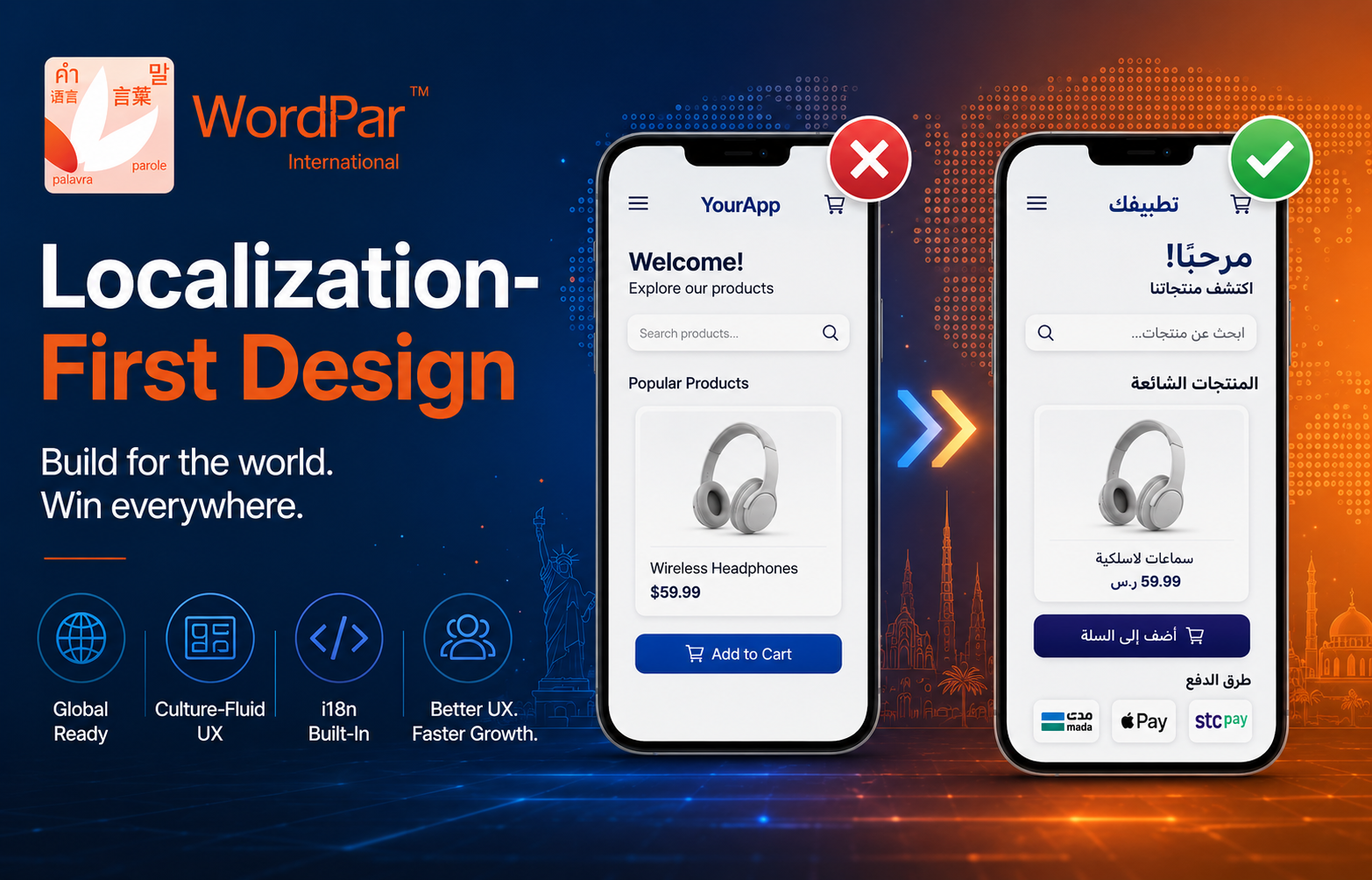
Users expect products to feel natural in their own language and culture.
A product designed for global audiences provides:
- Familiar navigation
- Localized content
- Regional formats
- Culturally relevant experiences
This makes users feel that the product was created specifically for them.
Effective UX localization is not just about translating text—it is about adapting the entire experience.
3. Faster Market Entry
Companies that integrate localization early can launch in new regions faster.
Instead of rebuilding products for every market, teams can quickly adapt:
- Languages
- Payment methods
- Regional preferences
- User interfaces
This creates a stronger global product design strategy.
4. Cost Savings
Localization-first development reduces future expenses.
Building a product correctly from the beginning is significantly more affordable than redesigning an existing application for international markets.
Key Principles of Localization-First Design
1. Internationalization (i18n) From Day One
Internationalization is the technical foundation that makes localization possible.
A strong internationalization (i18n) strategy includes:
Unicode Support
The system must support different character sets and writing systems beyond Latin alphabets.
Right-to-Left (RTL) Support
Languages such as Arabic, Hebrew, and Urdu require right-to-left layouts.
Applications must dynamically adjust:
- Text direction
- Navigation
- Interface positioning
- Visual hierarchy
Text Expansion and Contraction
Different languages require different amounts of space.
For example, German text can be significantly longer than English, while some Asian languages may require less space.
Interfaces must be flexible enough to support these variations.
Date, Time, and Number Formatting
Global products must support regional differences in:
- Currency
- Dates
- Times
- Numbers
- Measurement systems
Pluralization and Gender
Many languages contain complex grammatical rules.
The product architecture must support different plural forms and gender variations.
2. Culture-Fluid UX
A successful product does not only adapt language—it adapts culture.
Culture-fluid UX ensures that products feel natural across different markets.
Important considerations include:
Payment Methods
Users expect familiar payment options.
Examples include:
- WeChat Pay in China
- iDEAL in the Netherlands
- Boleto in Brazil
Visual Design
Colors, icons, imagery, and symbols may have different meanings across cultures.
Design choices must consider local expectations.
Navigation and Layout
Different cultures may have different preferences for:
- Information structure
- Navigation patterns
- Visual presentation
Trust Signals
Local certifications, reviews, and testimonials help establish credibility.
3. Content Architecture
A localization-ready product requires strong content architecture.
Separate Content From Code
Text should be stored separately from application code so it can be translated without technical changes.
Provide Context for Translators
Translators need information such as:
- Where text appears
- Character limitations
- Intended tone
- User context
Continuous Localization
Localization should become part of the development workflow.
New features and content should be prepared for global markets immediately.
The Commercial Reality for Product Teams
For CTOs, Product Managers, and UX designers, localization-first design is a competitive advantage.
Scalable Global Growth
Products designed for localization can expand into new markets faster.
Improved User Satisfaction
Users across different regions experience products that feel natural and relevant.
Reduced Costs
Companies avoid expensive redevelopment by planning localization early.
Competitive Advantage
Businesses that prioritize localization-first design enter markets faster and build stronger customer relationships.
The WordPar Advantage
At WordPar, we help product teams create global-ready digital experiences.
Our services include:
Localization Consulting
We advise teams on internationalization best practices and global product strategies.
UI/UX Localization
We adapt interfaces for global audiences, including:
- RTL support
- Cultural adaptation
- Multilingual experiences
Continuous Localization
We integrate localization into development workflows so products remain ready for global expansion.
Quality Assurance
We ensure localized products maintain accuracy, usability, and consistency across markets.
Don't retrofit localization.
Build it in from the start.
Frequently Asked Questions (AEO)
Localization-first design is a product development approach where global usability and multilingual support are considered from the beginning instead of being added later.
Localization helps products adapt to different languages, cultures, and markets while reducing technical costs and improving user experience.
Internationalization (i18n) prepares a product technically for different markets, while localization adapts the product for specific languages and cultures.
Supporting RTL languages ensures users of Arabic, Hebrew, and Urdu can interact with products naturally without layout or usability issues.
Conclusion
The future of global products is not about building in one language and adapting later.
The companies that succeed internationally will design for global audiences from the beginning.
Localization-first design helps businesses create scalable, culturally relevant, and user-friendly products that work everywhere.
Don't retrofit localization.
Build global readiness into your product from day one.
🌐 Visit our blog for more insights: https://wordpar.com/blog/
🔗 Connect with us on LinkedIn: https://www.linkedin.com/company/64626783/admin/dashboard/
Explore WordPar Localization Services →WordPar is a global localization partner specialising in translation, localization, legal translation, e-learning localization, pharmaceutical translation, HR verification translation, technical translation, voiceover creation, subtitling, AI-powered translation, and transcreation. We combine cutting-edge AI technology with human expertise to deliver accurate, culturally resonant, and secure global content. Our ISO 27001 certification ensures the highest standards of data security for our clients.