

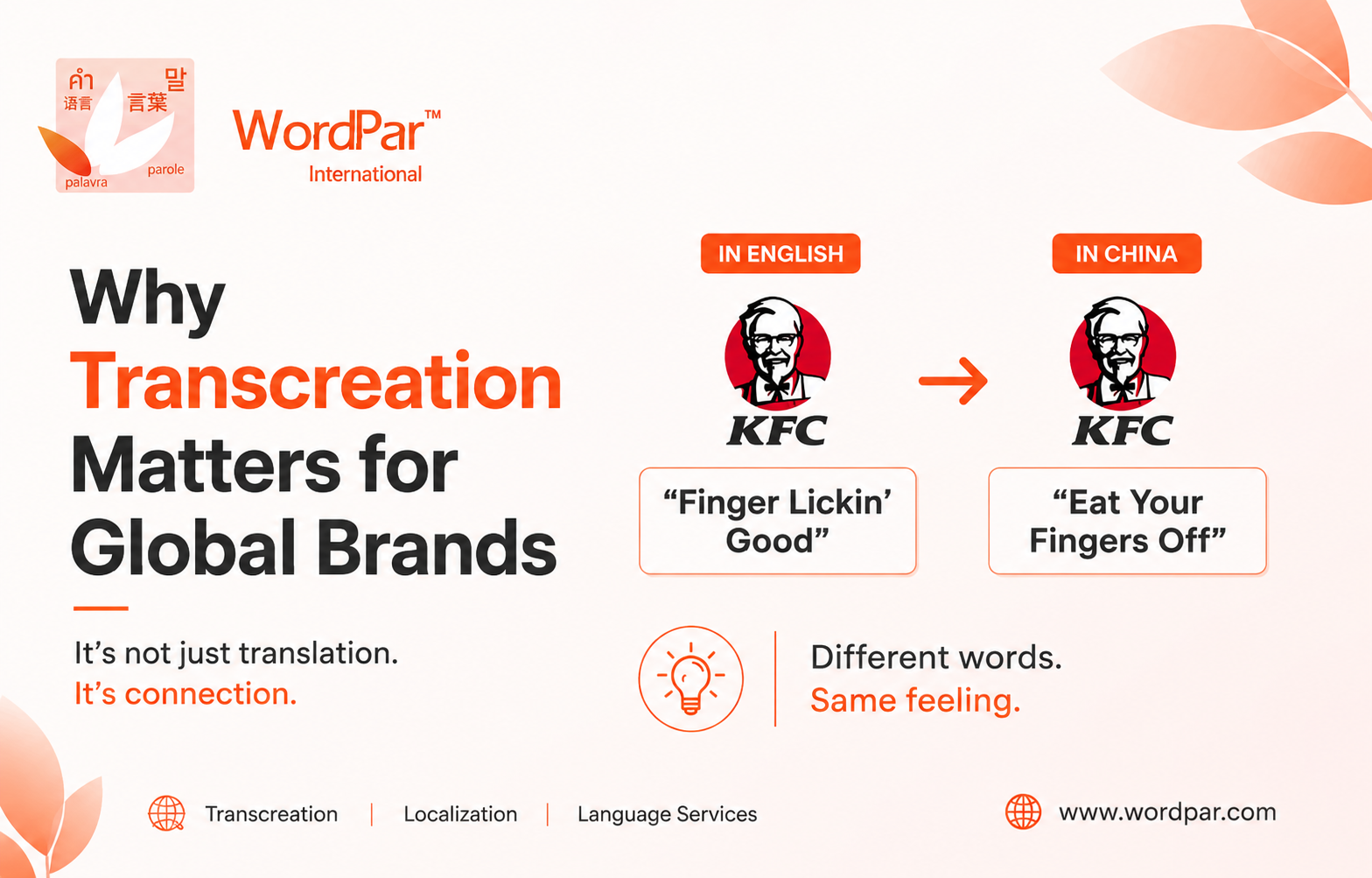
"Finger Lickin' Good" Became "Eat Your Fingers Off": The Art of Transcreation
SUMMARY
Transcreation goes beyond literal translation by adapting a message to preserve its emotional impact, cultural meaning, and brand voice. The KFC China example shows how direct translation can fail, while effective transcreation helps global brands connect with local audiences.
"Finger Lickin' Good" Became "Eat Your Fingers Off." Here's Why Transcreation Matters for Global Brands
It is one of the most famous localization fails in history. When KFC expanded into China, their iconic slogan "Finger Lickin' Good" was converted word-for-word into Mandarin. The result? "Eat Your Fingers Off." Not quite the mouth-watering invitation they intended. This is not just a funny anecdote — it is a masterclass in why transcreation exists, and why translation vs transcreation is one of the most important distinctions any global brand needs to understand before entering a new market.
What Is Transcreation?
Transcreation is the art of creative adaptation: taking a message built for one market and recreating it for another while preserving its intent, style, tone, and emotional impact. It is a hybrid discipline — part linguist, part copywriter, part cultural consultant. A transcreator does not ask "What do these words mean in language B?" They ask "What feeling does this create, and how do I recreate that feeling for a completely different audience?"
According to industry experts at Lokalise, transcreation is best understood as "creative translation" — content reconstructed from the ground up so that it evokes the same emotional response in the target culture. This makes it fundamentally different from standard translation, which prioritises linguistic accuracy above all else. When it comes to marketing localization, accuracy alone is never enough.
What Is the Difference Between Translation vs Transcreation?
The distinction is simple but critical. Translation finds the closest linguistic equivalent. Transcreation finds the closest emotional equivalent. The table below shows where each approach belongs:
| Dimension | Translation | Transcreation |
|---|---|---|
| Primary goal | Linguistic accuracy | Emotional & cultural resonance |
| Typical content | Legal, technical, medical documents | Slogans, taglines, ad copy, campaigns |
| Freedom with source | Minimal — stays close to source | High — may rewrite entirely |
| Brand voice preservation | Partial | Full — central to the process |
| Cultural adaptation | Limited | Deep — idioms, humour, references all adapted |
| Risk of failure | High for marketing content | Low when done by experts |
When the content being adapted carries emotional weight — humour, aspiration, urgency, desire — you need transcreation, not translation. A literal slogan translation of "Just Do It," "Think Different," or "Finger Lickin' Good" will almost always fall flat or cause offence in a new market without creative adaptation.
The KFC Story: A Localization Fail That Became a Transcreation Lesson
When KFC entered China in the 1980s, "Finger Lickin' Good" was translated literally into Mandarin, producing a phrase that effectively meant "Eat Your Fingers Off." The original is an English idiom — an exaggerated, playful claim that the food is so delicious you will lick your fingers. Translated word-for-word, it lost every scrap of that playful intent and became a strange, slightly threatening instruction.
This is one of the most studied localization fails in global marketing history precisely because it illustrates the danger so vividly. The words were technically converted from one language to another. But the meaning — the feeling — was destroyed entirely.
KFC did not give up. Working with local agencies, the brand developed a new slogan for the Chinese market that captured the spirit of confidence and quality. The result — "We Do Chicken Right" — was not a slogan translation. It was a full creative adaptation: catchy, culturally appropriate, and emotionally aligned with how the Chinese audience experiences a great meal. This is transcreation at its best.
Why Does Transcreation Matter for Global Marketing?
The KFC example is famous, but localization fails happen every day — quietly draining marketing budgets and damaging brand equity. Here is why transcreation is a non-negotiable investment for brands entering new markets:
- Humour does not translate. What makes one culture laugh will confuse or offend another. Transcreation experts understand the target market's comic sensibility and adapt accordingly.
- Idioms and wordplay are invisible traps. "It's raining cats and dogs," "Break a leg," "Cost an arm and a leg" — none of these survive literal slogan translation. A skilled transcreator finds the culturally equivalent idiom that evokes the same image and feeling.
- Emotional resonance is the whole game. The most powerful marketing works because it makes people feel something. Marketing localization that stops at language conversion misses the emotion entirely.
- Brand voice must travel. A brand's personality, tone, and values must remain consistent across every market. Transcreation ensures your brand voice is not flattened into generic copy when it crosses a border.
- Cultural adaptation protects brand reputation. A misstep can offend an entire market. Thorough cultural adaptation builds trust rather than destroying it.
Is Transcreation Only for Slogans?
No — and this is a common misconception. While slogans and taglines are the most visible examples of translation vs transcreation decisions, the principle applies across all marketing touchpoints. Brand localization through transcreation covers:
- Ad headlines and body copy
- Social media campaigns and local hashtag strategies
- Email subject lines and CTAs
- Video scripts and voiceover copy
- Brand names and product names entering new markets
- Landing pages and campaign microsites
Any content where emotion, aspiration, or persuasion is the primary driver is a candidate for transcreation. The moment you are trying to make someone feel something — excited, reassured, entertained, inspired — you have moved beyond the territory of straightforward translation and into creative adaptation.
What Does the Transcreation Process Actually Look Like?
Professional transcreation is not a single-step conversion. At WordPar's transcreation & copywriting service, the process is a structured collaboration between linguists, creative writers, and market specialists. It typically involves:
- Creative brief: Understanding the source message's intent, tone, emotional goal, and target audience for the new market.
- Cultural audit: Identifying idioms, references, or concepts that will not land — the invisible landmines in the original copy.
- Conceptual recreation: Writing new copy that achieves the same emotional outcome using culturally resonant language and references.
- Back-translation review: Verifying that the adapted copy conveys the intended meaning back to the original market team.
- Client approval: Presenting two or three creative adaptation options so the client can choose the version that best fits their brand voice.
This is very different from running copy through a translation engine and hoping for the best. It is a creative service — and it is priced accordingly, because the value it protects is enormous.
The Commercial Reality of Brand Localization
For brands entering new markets, transcreation is not a luxury — it is a risk management tool. A literal slogan translation can:
- Fail to connect: Your message will not resonate emotionally with the target audience, and global marketing budgets will be wasted.
- Offend or confuse: Cultural missteps during brand localization can generate negative press and damage brand equity in markets you are just starting to build.
- Erode brand consistency: If your brand voice sounds different in every market, you undermine the global brand identity you have invested in building.
- Waste the entire campaign budget: A marketing localization failure is not just embarrassing — it can mean writing off a six-figure campaign spend.
The KFC "Eat Your Fingers Off" story is funny in hindsight. The brands that have not yet told their version of that story are the ones who invested in proper transcreation from the start.
Frequently Asked Questions
Transcreation is the process of creative adaptation — recreating a message for a new market while preserving its intent, tone, style, and emotional impact. Unlike translation, which finds the closest linguistic equivalent, transcreation finds the closest emotional equivalent. For marketing localization, this distinction is everything.
KFC's iconic slogan was translated literally into Mandarin, producing a phrase meaning "Eat Your Fingers Off." The original is an English idiom implying the food is delicious, but a word-for-word slogan translation stripped away all cultural and emotional meaning. It became one of the most studied localization fails in global marketing history — a textbook case for why transcreation is essential.
Whenever the content carries emotional weight — humour, aspiration, urgency, desire — you need transcreation, not translation. Slogans, ad headlines, social media campaigns, and taglines almost always require creative adaptation and thorough cultural adaptation. Technical or legal documents generally need translation; marketing content needs transcreation.
Final Thoughts
The gap between translation vs transcreation is the gap between a message that lands and a message that misfires. Every global brand faces this choice. Literal slogan translation is cheaper in the short term, but the cost of a failed brand localization — in wasted spend, in reputation damage, in missed market opportunity — is far greater than the investment in proper transcreation.
KFC recovered from "Eat Your Fingers Off." Not every brand gets a second chance. The smart move is to get it right the first time, with native-speaking creative experts who understand both your brand voice and the cultural nuances of your target market. That is what transcreation delivers. And that is what WordPar does for global marketing campaigns every day.
Don't Let Your Slogan Get Lost in Translation
Talk to WordPar's transcreation and marketing localization experts about adapting your campaigns for global markets — with the cultural precision your brand deserves.
Explore WordPar Transcreation Services →WordPar is a global localization partner specialising in translation, localization, legal translation, e-learning localization, pharmaceutical translation, HR verification translation, technical translation, voiceover creation, subtitling, AI-powered translation, and transcreation. We combine cutting-edge AI technology with human expertise to deliver accurate, culturally resonant, and secure global content. Our ISO 27001 certification ensures the highest standards of data security for our clients.