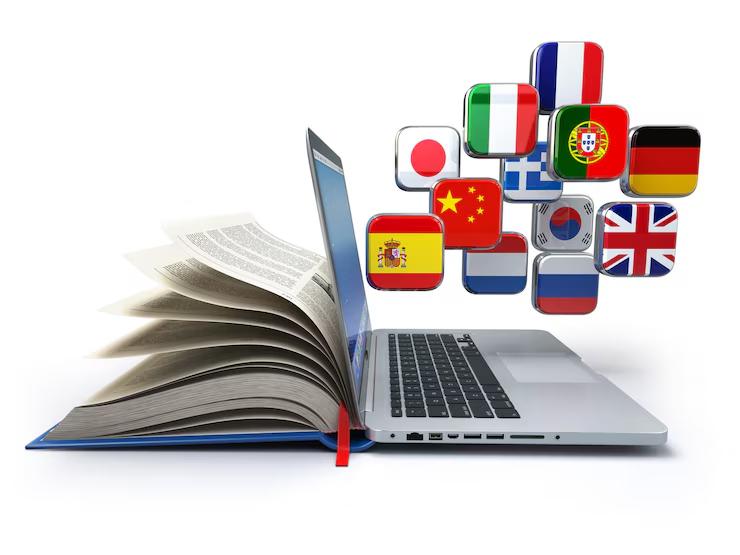
In a world where seamless cross-cultural communication is vital, professional translation services are evolving rapidly. The goal of many linguistic AI programs has been to create a world where people can understand one another—across language barriers, despite language differences, and ultimately through language itself.
With tools like AI-powered translation, instant voice recognition, and real-time interpretation, communication is getting faster and smarter. Yet, even the best machines today still struggle with what human translators have long faced—preserving meaning. Translation goes beyond word-for-word replacement; it involves understanding semantics, syntax, idioms, and culture. That’s where the human element remains indispensable.
The Shift from Lexical Replacement to Intelligent Translation
In early machine translation, developers focused on mechanical word substitution. These models often ignored syntactic reordering, cultural nuance, or grammatical structures unique to certain languages. The problem? Developers were not linguists—and linguists were not developers.
This led to a disconnect where automated translations resembled cryptic codes rather than clear communication. Thankfully, this has changed. Today, interdisciplinary collaboration between software developers and linguists has reshaped AI-powered translation, leading to smarter, context-aware engines.
Human + Machine: A Productive Partnership
The modern approach embraces machine-assisted human translation, where artificial intelligence acts as a powerful support tool. It helps professional translators increase productivity—doubling daily word counts, ensuring consistency, and speeding up delivery.
For professionals across industries—doctors, lawyers, bankers—AI can instantly summarize complex documents, offering a quick and useful first draft. This blend of human skill and machine precision is the foundation of today’s professional translation services.
Meeting Global Business Demands
Globalization and digital transformation have massively increased the need for translation services for businesses. Whether it’s website content, product manuals, or legal contracts, companies require fast, accurate translations to stay competitive.
Machine translation helps scale up output and maintain quality—allowing businesses to meet growing demands without compromising precision. This high-volume need has positioned AI-powered translation as a cornerstone of enterprise language strategy.
Enhancing Accuracy with Technology
Modern AI systems now support translators by generating clean, consistent drafts, reducing repetitive strain, and preserving terminological accuracy. Think of machine translation not as a replacement, but as a smart, always-ready assistant—similar to a word processor, but designed for multilingual precision.
While machines may never fully replace human linguistic nuance, they’ve earned their place in the translator’s toolkit. The result? Faster turnaround, improved quality, and the ability to serve clients at scale through professional translation services enhanced by technology.
Conclusion
AI-powered translation is transforming the way the world communicates. With smarter tools and collaborative workflows, translation companies can now meet global demands with unmatched speed and quality. As the demand for translation services for businesses grows, the synergy between human expertise and machine intelligence ensures language is no longer a barrier—but a bridge.