
How Legal Translation Errors Cause Multi-Million Liabilities
SUMMARY
In cross-border contracts, patents, and regulatory filings, a single mistranslated word like “shall” vs. “may” can dismantle legal enforceability, leading to forfeited intellectual property and multi-million-dollar lawsuits. Protecting global business assets demands certified legal translators, deep jurisdictional expertise, and rigorous dual-linguist review rather than unvetted machine translation.
The “Language of Trust”: How Legal Translation Errors Become Multi-Million Dollar Liabilities
A single word can cost you millions. In legal translation, it often does.
In most industries, a translation error is merely an embarrassing inconvenience. A clumsy marketing slogan might cause a brief social media chuckle; a mistranslated product manual might generate extra customer support tickets. But in cross-border legal transactions, an inaccurate translation is not an inconvenience—it is an existential liability.
Legal documents are the bedrock of commerce. Cross-border contracts, patent portfolios, master services agreements, shareholder compacts, and international regulatory filings carry binding legal obligations. When these instruments are translated inaccurately, the downstream consequences are severe: unenforceable agreements, compromised intellectual property, punitive regulatory sanctions, and protracted multi-million dollar litigation.
The High Stakes of Legal Translation
Legal translation is never an exercise in literal word-swapping; it is the art of preserving precise legal intent across disparate jurisprudence systems. This demands far more than linguistic fluency. It requires three foundational capabilities:
1. Deep Comparative Jurisprudence Knowledge
Translators must thoroughly understand both the source and target legal systems (e.g., Common Law vs. Civil Code). A doctrine that carries centuries of settled case law in one jurisdiction may have no conceptual equivalent in another. Without deep legal training, translators inevitably introduce ambiguity where courts require absolute certainty.
2. Absolute Terminological Precision
In legal drafting, near-synonyms do not exist. A “warranty” is legally distinct from a “guarantee.” An “indemnity” conveys vastly different obligations than a “hold harmless” covenant. Conflating these terms rewires the risk profile of an agreement, shifting millions in exposure onto an unsuspecting party.
3. Cultural and Statutory Context
Legal terminology is bound to regional statutory history. When a concept exists only in the source territory, the translator must know whether to employ established statutory equivalents or craft an accurate descriptive translation that upholds enforceability before international arbitration panels.
Common Legal Translation Errors and Their Consequences
1. Mistranslated Contract Terms: The “Shall” vs. “May” Trap
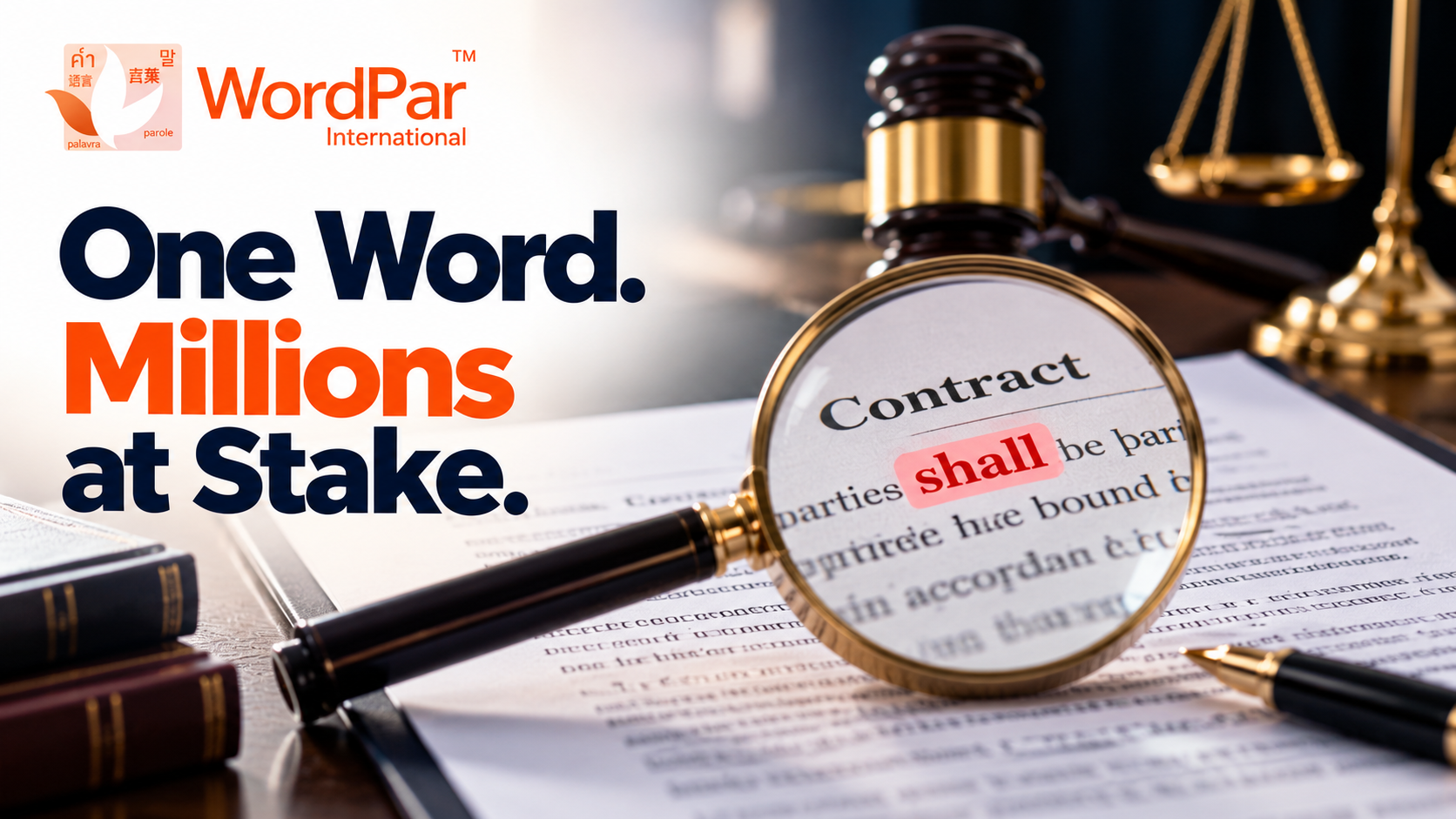
In contract drafting, modal verbs define obligations. Translating “shall” (a mandatory obligation) as a permissive discretionary term like “may” completely dismantles a party's contractual remedies. When milestones slip or supply commitments break down, tribunals refuse to enforce damages because the translated language made compliance optional.
2. Inaccurate Patent Translations: Loss of Exclusivity
In technology and pharmaceuticals, patent claims represent billions in R&D. An inaccurate translation of an independent patent claim can inadvertently narrow your scope of protection or leave an inventive step unshielded. Competitors can exploit these linguistic loopholes to bring infringing generic alternatives to market without legal repercussion.
3. Non-Compliant Regulatory Filings
Healthcare, clinical trials, and financial institutions operate under strict regulatory reporting statutes. Submitting filings with terminology errors leads to immediate rejection, clinical trial suspensions, punitive fines, or the costly revocation of operating licenses.
4. Misinterpreted Cross-Border Employment Contracts
During international M&A or HR verification, imprecise employment contracts frequently cause severe labor disputes regarding severance covenants, restrictive covenants, and statutory benefits. What was intended as standard executive language can trigger mandatory union obligations under local labor codes.
The Commercial Reality: Risk Management, Not Administrative Overhead
For general counsels, compliance officers, and international operations leads, certified legal translation is not an administrative cost center—it is an essential risk-mitigation policy. The minor savings from bargain translation agencies or unvetted AI engines are obliterated when an error surfaces:
- Litigation Costs: Cross-border commercial disputes routinely incur hundreds of thousands in jurisdictional and attorney fees before ever reaching trial.
- Forfeited Revenue: Defective patent filings compromise market exclusivity and erase multi-million dollar early-mover advantages.
- Statutory Sanctions: Regulatory bodies issue severe compounding fines for defective or misleading foreign-language filings.
- Erosion of Institutional Trust: Material translation errors expose executive negligence and undermine investor and partner confidence.
Comparison: Casual Translation vs. Certified Legal Translation
| Legal Vulnerability | Casual / Unvetted Translation | WordPar Certified Legal Practice |
|---|---|---|
| Contract Obligations | Translates “shall” into permissive verbs; unbinding commitments | Preserves mandatory vs. discretionary statutory distinction |
| Patent Scope & Claims | Loose terminology narrows protection or exposes loopholes | Dual review by patent linguists to protect patent exclusivity |
| Regulatory Compliance | Fails local disclosure statutes; risk of audits and penalties | Strict compliance validation with local jurisdictional codes |
| Data Security & Privilege | Consumer cloud tools; potential breach of confidentiality | ISO 27001-certified data handling & strict NDAs |
← Swipe horizontally to view the full comparison →
The WordPar Advantage: Translating Legal Meaning, Not Just Words
At WordPar, our legal translation division operates as an institutional safeguard for global organizations. Our certified legal linguists specialize in corporate governance, intellectual property, complex litigation, and international regulatory filings.
- Rigorous Dual-Linguist Workflow: Every legal instrument is translated by a certified legal translator and independently vetted by a senior legal proofreader.
- In-Jurisdiction Legal Review: For critical cross-border transactions, our network includes qualified attorneys who verify statutory alignment within the destination jurisdiction.
- ISO 27001-Certified Security: Confidential briefs, proprietary patent claims, and litigation filings are guarded by enterprise-grade cryptographic security protocols.
- Official Certification & Notarization: We provide formal certificates of accuracy recognized by courts, patent registries, and administrative agencies worldwide.
Frequently Asked Questions
Can AI tools like ChatGPT or DeepL be used for legal contracts?
No. Consumer AI engines cannot evaluate jurisdictional nuances, often hallucinate legal terminology, and lack legal accountability. Furthermore, pasting privileged contracts into third-party AI models risks serious breaches of client confidentiality and non-disclosure obligations.
What is a certified legal translation?
A certified legal translation is accompanied by an official, signed statement attesting to the completeness and accuracy of the translation against the original source document, making it admissible in courts, government registries, and regulatory bodies.
How does WordPar ensure confidentiality for sensitive filings?
WordPar operates under ISO 27001-certified information security management systems. All team members and legal linguists are bound by strict non-disclosure agreements (NDAs), and all files are processed across encrypted, secure infrastructure.
Why is dual translation necessary for legal documents?
Dual translation pairs a primary certified translator with an independent senior legal reviewer. This ensures that no single oversight, omitted phrase, or ambiguous term can compromise the legal enforceability of the final document.
Final Thoughts: Protect Your Most Valuable Assets
Your contracts, intellectual property, and compliance filings define your organization's global standing. Treating legal translation as an administrative commodity invites catastrophic risk. By partnering with certified legal translation experts, you protect your bottom line, preserve partner trust, and ensure full cross-border legal enforceability.
Safeguard Your Global Contracts with Certified Legal Translation
Don't allow a single mistranslated clause to jeopardize your international operations. Partner with WordPar’s ISO 27001-certified legal translation practice for meticulous, court-ready accuracy.
Request a Confidential Legal Translation Consultation →Executive Key Takeaways • Legal Risk Mitigation
- Meaning Over Words: Legal translation must preserve cross-jurisdictional enforceability, not just literal syntax.
- The “Shall/May” Liability: Imprecise modal verbs turn binding commitments into unenforceable suggestions.
- Patent Exclusivity: Vague claim translations expose multi-million dollar intellectual property to domestic competitors.
- Dual Review Standard: Critical legal filings demand a primary certified translator paired with an independent legal editor.
- Confidentiality Mandate: Privileged legal records require ISO 27001-certified handling to prevent data exposure.
About WordPar
WordPar is a global localization partner specializing in translation, localization, legal translation and certification, e-learning localization, pharmaceutical translation, HR verification translation, technical translation, voiceover creation, subtitling, AI-powered translation, and transcreation. We combine cutting-edge AI technology with certified human legal expertise to deliver accurate, culturally resonant, and secure global content. Our ISO 27001 certification ensures the highest standards of data security for our clients.
Visit our blog for more insights, or connect with us on LinkedIn.