

Lost in Translation? How a Simple Text Break Can Turn Your German Translator into a “Grammar Rebel”
SUMMARY
Using a German example, it explains how a phrase that appears to be an error is often a logical response to missing context. The article shows how isolated text fragments can shift a sentence from an infinitive to a command. It emphasizes that such issues usually stem from source-text structure, not translator mistakes. The key message is clear: providing full context is essential for accurate and effective localization.
A Light hearted Guide to Why Your “Bad Translation” Might Actually Be a Hidden Language Superpower
Introduction: The “Error” That Wasn’t
Picture this: You’re reviewing a freshly translated German module, and you spot this:
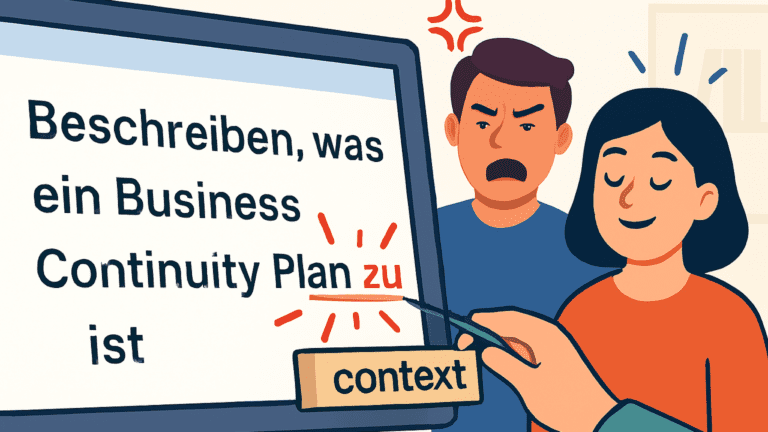
Am Ende dieses Moduls werden Sie in der Lage sein: Beschreiben, was ein Business-Continuity-Plan ist.
“Aha!” you think. “The translator forgot the ‘zu’! This is clearly wrong. It should be ‘zu beschreiben’!”
Before you fire off that angry email to your translation agency, let’s take a deep breath. What if I told you the real culprit isn’t your translator—it’s a sneaky little thing called syntax? And you might have accidentally set a trap for them without even knowing it.
Part 1: The Lone Ranger “Describe…”
Let’s play a quick game. Look at this English phrase all by itself:
Describe what a business continuity plan is.
What does it sound like to you?
A) A friendly suggestion
B) A statement of fact
C) A command
If you answered C, congratulations! You’ve just experienced imperative mood in action. When “Describe…” stands alone in English, it feels like an instruction, like a teacher telling a student what to do.
Now, imagine this phrase sitting in a spreadsheet cell, isolated from its friends. To an English speaker, it’s clearly a command. No questions asked.
Beschreiben Sie, was ein Business-Continuity-Plan ist.
Part 2: Bringing in the Big Guns: The Full Sentence
Now let’s give “Describe…” some context. Meet its best friend, the introductory clause:
By the end of this module, you will be able to: Describe what a business continuity plan is.
Suddenly, “Describe” isn’t a command anymore—it’s part of a statement. It’s now a declarative infinitive, tucked neatly after “to.” The mood shifts entirely. It’s no longer “Do this!” but “You will be able to do this.”
See the magic? Just a few words before it, and the meaning changes completely.
Part 3: The German Dilemma – Where Syntax Is King
Here’s where it gets tricky for translators. German grammar is very particular about verb placement. In a full sentence like the one above, the infinitive verb needs its little partner “zu” (meaning “to”) to behave properly in this context.
So in German, the correct translation of the full statement is:
Am Ende dieses Moduls werden Sie in der Lage sein: zu beschreiben, was ein Business-Continuity-Plan ist.
But what if the text is split? What if “Describe…” is delivered to the translator without “By the end of this module, you will be able to”?
The translator sees an imperative. And in German, the imperative of “beschreiben” is:
Beschreiben Sie, was ein Business-Continuity-Plan ist.
But wait—you didn’t want “Sie” (the formal “you”) in there, did you? Because in your source, it wasn’t a command at all. It was just… a fragment.
Part 4: The Client’s Spreadsheet Trap
Now imagine this common scenario in localization:
Cell A1: “By the end of this module, you will be able to:”
Cell B1: “Describe what a business continuity plan is.”
The translator receives them separately. They translate Cell A1 perfectly. They see Cell B1—a lone “Describe…”—and think: Ah, this is the action item. It must be imperative.
And so, when concatenated, you get:
Am Ende dieses Moduls werden Sie in der Lage sein: Beschreiben, was ein Business-Continuity-Plan ist.
Cue the client’s alarm bells. “Error! Missing ‘zu’! Bad translation!”
But the translator wasn’t wrong—they were given a textual trap. The break in the text changed the linguistic mood, and they followed the clues they had.
Part 5: Who’s Really to Blame?
Let’s be honest: the real issue isn’t the translator or the agency. It’s the hidden structure of language that many non-linguists overlook. When you break a sentence across cells, slides, or lines, you risk changing its grammatical function.
It’s like giving a chef half a recipe and then complaining the cake tastes wrong.
Your translator is a language detective, working with the clues they’re given. If the clue says “command,” they’ll translate a command. If the clue says “infinitive,” they’ll translate an infinitive.
Conclusion: How to Avoid This Mess (and Keep Everyone Happy)
Provide full sentences whenever possible—don’t break them across cells unless absolutely necessary.
Add linguistic notes if a phrase is part of a larger structure (e.g., “This is part of a ‘will be able to…’ statement”).
Trust your linguists—they see things you don’t. What looks like an error might be a perfectly logical response to a poorly segmented source.
And next time you see a “mistake” in a translation, ask yourself:
Did I just give them half a sentence and expect a whole meaning?
Because in translation, context isn’t just king—it’s the whole kingdom.
Conclusion: A Gentle Nudge to the “Cell-Splitting Client”
Let’s be real for a moment: the challenge often isn’t the translator. It can start when breaking a sentence into spreadsheet cells is seen purely as “organizing,” without realizing it’s also quietly “rewriting grammar.”
You can’t give a translator half a thought and expect a whole sentence back. It’s like ordering a pizza, enjoying the crust, and then wondering where the toppings are. Spoiler: they were in the other box.
So next time there’s a temptation to question a translation for something like “missing the zu,” it helps to pause and ask:
Did I just cut a sentence in half and expect it to still walk straight?
This isn’t a failure of the translator—it’s a natural result of how language works when it’s segmented. Translators work diligently with what they’re given. When a phrase like “Describe what a business continuity plan is” appears alone, it naturally reads as an instruction. Add the preceding clause—“By the end of this module, you will be able to:” —and it transforms into a statement of capability.
Therefore, when a translation seems slightly off, it’s often worth a second look at how the source text was structured. A small shift in formatting can make a world of difference in meaning. When we bridge that gap together—client and translator—the results don’t just speak; they resonate.
About the Author
Vikram Malhotra is a linguist, polyglot, and founder of WordPar International. He believes the best translations come from seamless collaboration—and a shared appreciation for the hidden rhythms of language.